Chenille is one of five patch types most custom orders come down to, and it is very good at a narrow job and poor at everything outside it. Before you commit a logo to fuzzy yarn, it helps to see chenille next to the alternatives so you know whether it is the right tool or the wrong one. This is a straight comparison of chenille, embroidered, woven, PVC, and leather patches: what each holds, how each feels, where each lasts, and what drives the cost of each.
The single question that sorts them is how much detail your artwork carries. A bold letter or a simple crest is happy in almost any material; a logo with fine lines, small text, or many colors rules some options out immediately. Keep your actual artwork in mind as you read, because the right answer changes completely between a two-letter monogram and a detailed company mark.
Chenille: bold, tactile, and built for jackets
Chenille is looped yarn on a felt base, and it reads as texture more than as image. That fuzzy, raised surface is exactly why it owns the varsity and letterman world, where a single large letter or a simple mascot shape is the whole design. Its weakness is the flip side of that strength: it cannot hold fine lines, small text, or gradients, so a detailed logo turns to mush. Chenille also wants room to work, usually around three to four inches at minimum and often much larger, and because the finished patch is thick and heavy it is normally sewn on rather than ironed on. It is durable through washing but is not weatherproof, so it belongs on garments, not gear left in the rain.
Embroidered: the versatile default
Embroidered patches are raised thread on a backing and they are the all-rounder most buyers picture. They hold a clean logo and readable lettering, come in a wide range of thread colors, survive repeated washing, and suit everything from work shirts to caps. They do have a detail ceiling: very small text and hairline elements do not reproduce well in thread, so a busy logo may need simplifying. For the majority of company and team patches at two to four inches, embroidery is the safe, familiar choice.
Woven: the one for fine detail
When the artwork has small text or thin lines, woven is the type that saves it. Woven patches are made from fine threads on a loom rather than stitched, producing a flat, smooth surface that captures the finest detail and the smallest legible lettering of any option. The trade-off is texture: they lack the raised, dimensional feel of embroidery, and they read as crisp and modern rather than classic. If your logo has a tagline in small type or intricate linework, woven is usually the only type that keeps it sharp.
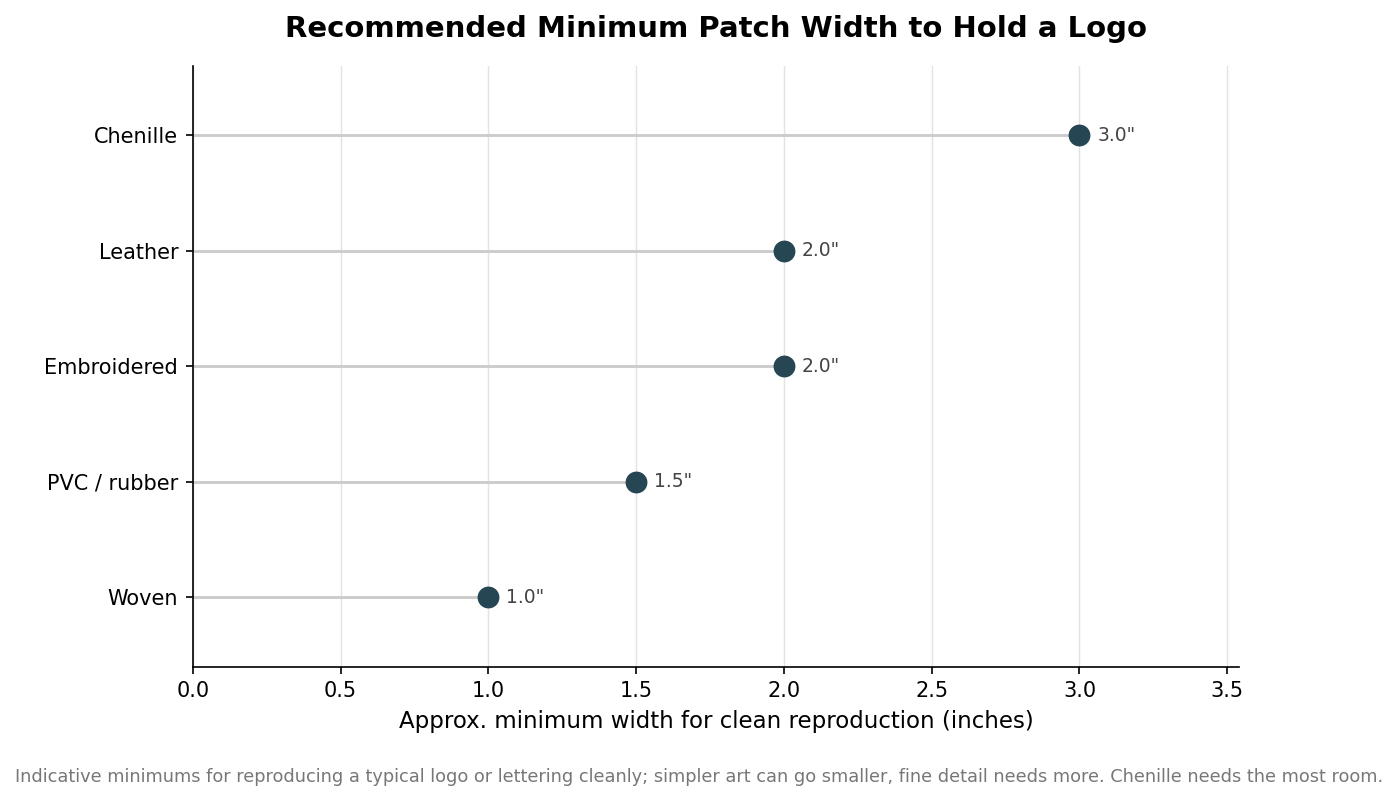
The minimums above are indicative rather than rules, but they capture the ranking: woven can shrink smallest while still holding a logo, embroidery and leather sit in the middle, and chenille needs the most room before a design reads. Match the type to the smallest element in your art, not to the overall patch size.
PVC and rubber: waterproof and dimensional
PVC patches are molded rubber, not thread, which makes them fully waterproof and weatherproof and gives them a raised, three-dimensional look. That combination is why they dominate tactical gear, outdoor equipment, and anything exposed to weather, where a thread patch would soak and fray. They render bold, layered shapes well but with less crispness than woven, and because each design needs a mold there is a one-time tooling cost that favors larger runs. For a bag, a hat worn hiking, or a hook-and-loop morale patch, PVC outlasts the alternatives.
Leather: rugged and heritage
Leather patches, usually laser-engraved or debossed rather than colored, deliver a rugged, heritage look that suits caps, work apparel, and outdoor brands. They carry a single-tone engraved mark cleanly but cannot do the multi-color fill that thread and PVC can, so they are a style choice as much as a functional one. Real leather also asks for a little care and is best kept off items that see heavy washing. When the look you want is understated and premium rather than bright and graphic, leather does something none of the others do.
Matching the patch to the job
Start from the smallest detail in your artwork and the environment the patch will live in. Fine detail points to woven; weather and water point to PVC; a big bold letter on a jacket points to chenille; a premium single-tone mark points to leather; and a straightforward color logo on apparel points to embroidery. Size follows the placement: hat and cap patches typically run two to two and a half inches, a left-chest patch around three to three and a half inches, a full jacket back ten to twelve inches, and a letterman letter anywhere from four to twelve. Thicker patches like chenille almost always use a sew-on backing, while thinner embroidered and woven patches can take iron-on or hook-and-loop.
Cost tracks type, size, quantity, and setup, so a small woven badge and a large chenille letter are not the same order; send your artwork and a rough quantity for a quote. The honest summary is that chenille is not a general-purpose patch. It is the best choice in the world for bold letters and simple shapes on jackets and team apparel, and the wrong choice for a detailed logo, a small badge, or anything that needs to shrug off the weather. Decide what the patch has to do first, and the material chooses itself.